
Intestinal Nematodes
Intestinal Nematodes
Editor: Peter Hotez
Section Contents
- Soil-transmitted helminths
- Ascaris lumbricoides (roundworm)
- Hookworms (Ancylostoma duodenale, Necator americanus)
- Trichuris trichiura (whipworm)
- Enterobius vermicularis (pinworm)
- Other intestinal nematodes of minor medical importance
- Anisakis spp.
- Oesophagostomum spp.
- Capillaria spp.
- Assessment: Did I Get It? (DIG-IT)
- Other Media Resources (Optional)
- References
Soil-transmitted helminths
Soil-transmitted helminths (STHs) or Geohelminthiasis are a group of intestinal nematodes that are transmitted by either ingestion or skin penetration of infective parasitic stages, and requires fecally contaminated soil as part of its life cycle. They are all found primarily in tropical and subtropical areas, and are highly associated with poverty, poor sanitary conditions, and low socioeconomic status.
In this module we will review: Ascaris lumbricoides (roundworm), Ancylostoma duodenale & Necator Americanus (hookworms), and Trichuris trichiura (whipworm). Strongyloides stercoralis (threadworm) is also a STH, but it has a lot of unique features, so we gave it a separate module.
Ascaris lumbricoides (roundworm)
General
Ascaris is the most common intestinal parasitosis worldwide. In 2021, Global Burden of Disease data from the Institute for Health Metrics and Evaluation (IHME) estimated about 294 million infections worldwide. Ascariasis is transmitted via fecal-oral contamination with infective eggs. Children are disproportionately affected. They are unique in that adult females can reach up to 30-40 cm in length and live in the small intestine.

Age-standardized DALY rates for Ascaris (taken from Global Health Metrics, Open Access)
Life Cycle
Please click below for a video on the life cycle:

Figure 1. Life cycle of Ascaris lumbricoides
Clinical Presentation
Most infections are asymptomatic +/- eosinophilia! When symptoms are present, they depend on the stage of the infection:
- Migratory stage (due to larval migration) → 1-2 weeks after initial exposure, individuals with a high parasitic burden -usually ingestion of hundreds of eggs-can experience interstitial pneumonitis, Loeffler’s syndrome (cough, fever, eosinophilia), migratory pulmonary infiltrates, and an asthma-like syndrome. Most symptoms improve after 1-2 weeks.
- Intestinal stage (due to adult parasites) → dyspepsia-like symptoms (e.g., abdominal pain, bloating, nausea), diarrhea. Depending on the parasitic burden, worms can be released through natural orifices (e.g. with cough, with stool).
- Complications: due to mechanical obstruction of the intestinal or the biliary lumen.
- Biliary obstruction - cholecystitis, cholangitis, pancreatitis.
- Appendicitis.
- Intestinal obstruction (only in heavy infections).
- Complications: due to mechanical obstruction of the intestinal or the biliary lumen.

Figure 2. Massive infection with Ascaris lumbricoides
Answer
Loeffler’s syndrome is seen in Ascaris spp., Strongyloides spp., and Hookworms (Ancylostoma duodenale, Necator americanus)
Diagnosis
Ascariasis can be diagnosed through:
- Direct visualization of adult worms: if expelled during coughing spells or in stool.
- Stool microscopy: may show Ascaris eggs - concentration techniques (e.g., Kato-Katz) are preferred. Note that infections with only male worms will not produce any eggs.
For more information on the morphology of the eggs, larvae, and adults, please visit the Parasites Wonders Blog.

Figure 3. Adults of Ascaris

Figure 4. Eggs of Ascaris
Treatment
Albendazole x 1 (mebendazole is an alternative).
- If Loeffler’s syndrome: consider steroids before giving anti-helminthic therapy.
- If intestinal/biliary obstruction: surgical or endoscopic therapy may be needed.
Hookworms (Ancylostoma duodenale, Necator americanus)
General
Unlike Ascaris, hookworms are transmitted via skin penetration of infectious larvae. In 2021, Global Burden of Disease data from IHME estimated that approximately 207 million people were affected by hookworms worldwide. Female worms can reach up to 9-13 mm (very different from 30-40 cm in Ascaris) and live in the small intestine. Necator americanus is responsible for roughly 3/4 of all hookworm cases.

Age-standardized DALY rates for hookworms (taken from Global Health Metrics, Open Access)
Life Cycle
Please click below for a video on the life cycle:

Figure 5. Life cycle of Hookworm
Clinical Presentation
Most infections are asymptomatic +/- eosinophilia! When symptoms are present, it depends on the stage of the infection:
- Migratory stage (due to larval migration) →
- Cutaneous symptoms: “Ground itch”: mild pruritic papular rash at the site of larval penetration.
- Respiratory symptoms (less common than Ascaris): 1-2 weeks after initial exposure, individuals with a high parasitic burden -usually infection with hundreds of larvae- can experience interstitial pneumonitis, Loeffler’s syndrome (cough, fever, eosinophilia), migratory pulmonary infiltrates, and asthma-like syndromes. Most symptoms improve after 1-2 weeks.
- Intestinal stage (due to adult parasites) → individuals can have non-specific GI symptoms (e.g., abdominal pain, nausea, vomiting, diarrhea). Intestinal symptoms are often due to concurrent infections.
- Complications:
- Iron deficiency anemia.
- Complications:
Diagnosis
Hookworm infection can be diagnosed through:
- Direct visualization of adult worms: can be seen incidentally during endoscopy.
- Stool microscopy: may show hookworm eggs (indistinguishable amongst each other). Concentration techniques (e.g., Kato-Katz) are preferred.
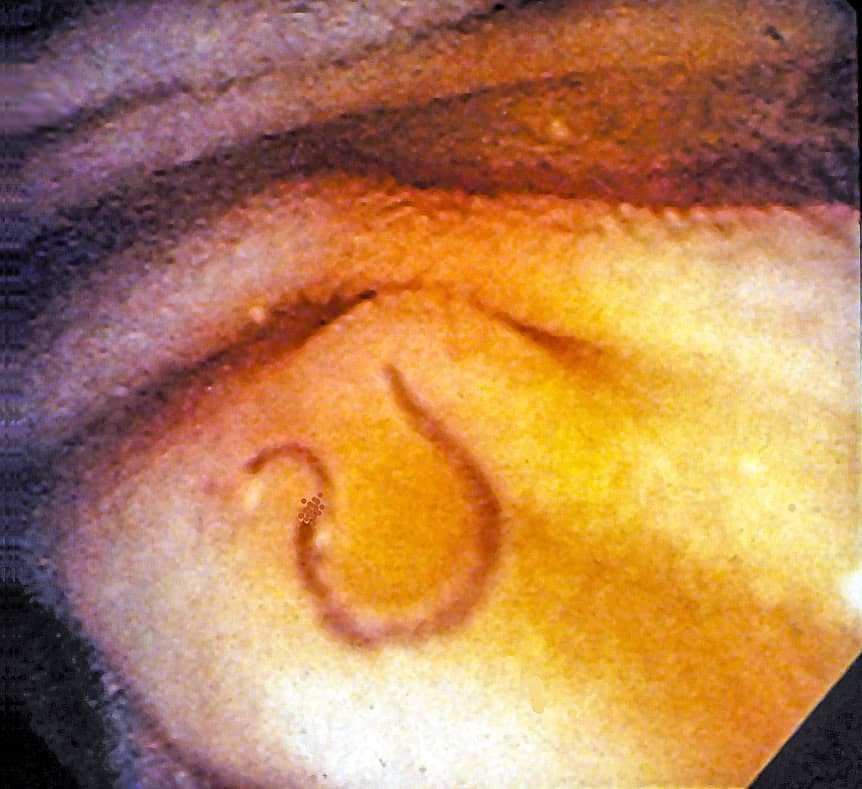
Figure 6. Adult hookworm seen in colonoscopy
Treatment
Albendazole (mebendazole is an alternative). Although one dose is recommended in most textbooks, for U.S. patients, some experts favor three daily doses of Albendazole.
- If Loeffler’s syndrome: consider steroids before giving anti-helminthic therapy.
- If anemia: rule out other causes, but consider iron supplementation.
Trichuris trichiura (whipworm)
General
Similar to Ascaris, whipworms are transmitted via fecal-oral contamination with infective eggs. In 2021, Global Burden of Disease data from IHME estimated that approximately 204 million people worldwide were affected by whipworm. Children are disproportionately affected. Female worms can reach up to 40-50 mm, and live in the colon.

Age-standardized DALY rates for Trichuris spp. (taken from Global Health Metrics, Open Access)
Life Cycle
For a video on the life cycle:

Figure 7. Life cycle of Trichuris trichiura
Clinical Presentation
Most infections are asymptomatic +/- eosinophilia! Eosinophilia, if present, is typically mild. When symptoms are present, it can include:
- Intestinal stage (due to adult parasites) → abdominal pain, tenderness, diarrhea (can be dysenteric).
- Complications: (rare)
- Anemia: long-standing damage to the mucosa can lead to chronic small blood losses.
- Trichuris dysentery syndrome (massive infantile trichuriasis): associated with chronic mucoid diarrhea, rectal bleeding, and finger clubbing.
- Rectal prolapse: if prolonged rectal tenesmus.
- Complications: (rare)
Diagnosis
Trichuriasis can be diagnosed through:
- Direct visualization of adult worms: can be seen incidentally during colonoscopy.
- Stool microscopy: looking for Trichuris eggs. Concentration techniques (e.g., Kato-Katz) are preferred.
For more information on the morphology of the eggs, and adults, please visit the Parasites Wonders Blog.

Figure 8. Adult of Trichuris

Figure 9. Egg of Trichuris
Treatment
Albendazole x 3 days (mebendazole is an alternative).
Enterobius vermicularis (pinworm)
General
Enterobius is sometimes considered a STH; however, unlike the other parasites we have reviewed so far, eggs do not necessarily need soil exposure to become infectious - so we decided to separate it. Children are disproportionately affected. Female worms can reach up to 10 mm, and live in the colon.
Life Cycle

Figure 10. Life cycle of Enterobius vermicularis
Clinical Presentation
Most infections are asymptomatic! When symptoms are present, it can include:
- Anal pruritus: typically nocturnal (when adults lay eggs) and can cause sleep disturbances.
- Complications:
- Secondary bacterial infections: from scratching in the perianum.
- Vaginitis: with scratching, worms can aberrantly migrate to the vagina.
- Complications:
Answer
Parasitic causes (Enterobius vermicularis, and less frequently, Taenia saginata). Others causes include hemorrhoids, anal fissures and neoplasias.