
Scabies
Scabies
Editors: Mónica Pachar, José Antonio Suárez, Laura Naranjo
Key Points
- Scabies is a neglected cutaneous tropical disease caused by the ectoparasite Sarcoptes scabiei (var hominis).
- Human scabies is transmitted primarily through direct skin-to-skin contact and it not transmitted by animals.
- Classic scabies is characterized by an intensely pruritic papulovesicular rash which spares sebaceous and hairy areas. Crusted scabies is characterized by hyperkeratotic crusts that result from severe infestation with the mite.
- Treatment involves both medication (either topical, oral in classic scabies - or both in crusted scabies) + treatment of social contacts and household members.
Background, Epidemiology & Transmission
Scabies is a neglected cutaneous tropical disease caused by the mite Sarcoptes scabiei (var hominis), which generally presents as two forms of disease: a classic and a crusted form (also called Norwegian). Scabies is highly contagious and widely distributed throughout the world, although more common in developing countries and tropical areas. In developed countries, infection is more commonly seen in the form of institutional outbreaks (e.g., in nursing homes, long-term care facilities, hospitals, schools).
It is fundamentally transmitted through direct skin-to-skin contact and requires at least 5-20 minutes of exposure. Thus, patients in overcrowded areas, in congregate settings, or those who are living under areas or poor sanitation are at greater risk of acquiring scabies. Transmission via fomites (e.g., clothing, bed linen) is not likely to be a major driver of transmission in classic scabies, but it plays a significant role in crusted scabies because hosts are heavily infested with mites.
Human scabies is NOT generally acquired from animals. Animal scabies (also called sarcoptic mange) can be transmitted to humans, but it is caused by other Sarcoptes species. Human infestations from animals are usually self-limiting.
Note: Transmission of scabies
- Direct skin to skin contact
- Fomites (more relevant in crusted scabies)
Note: Animals do not transmit human scabies
Pathophysiology
S. scabiei (var hominis) can survive outside the human host for no more than 5 days. When the host is infested, the adult female digs tunnel-like burrows over the stratum corneum, and it lays eggs. FYI - one female can lay eggs over a 1-2 month period. These eggs release larvae into the intact stratum creating the molting pouch and later maturing into adults. Adults mate and perpetuate the life cycle.
It takes about 10-14 days to complete the cycle in the human host. The exposure to parasitic antigens - including the mite, and its fecal material - induces an inflammatory response, leading to the vivid skin pruritus described in scabies infestation.
Crusted scabies - occurs when there is hyper-infestation with mites. Hosts may have millions of mites (as opposed to 10-15 mites in the classic form), which leads to the formation of hyperkeratotic skin crusts. This is primarily seen in the setting of T-cell immunodeficiency (e.g., HIV/AIDS, immunosuppressive medications, transplantation, HTLV-1 infection), those with physical and cognitive disabilities that impair the ability to scratch (e.g., Down syndrome, dementia, critical illness), or those with impaired cutaneous sensation (e.g., leprosy, neurological disorders).
Clinical Presentation
The incubation period is 2-6 weeks after a primary infestation and only 1-2 days with reinfestation. There are two main phenotypes of the disease. Click below to learn more:
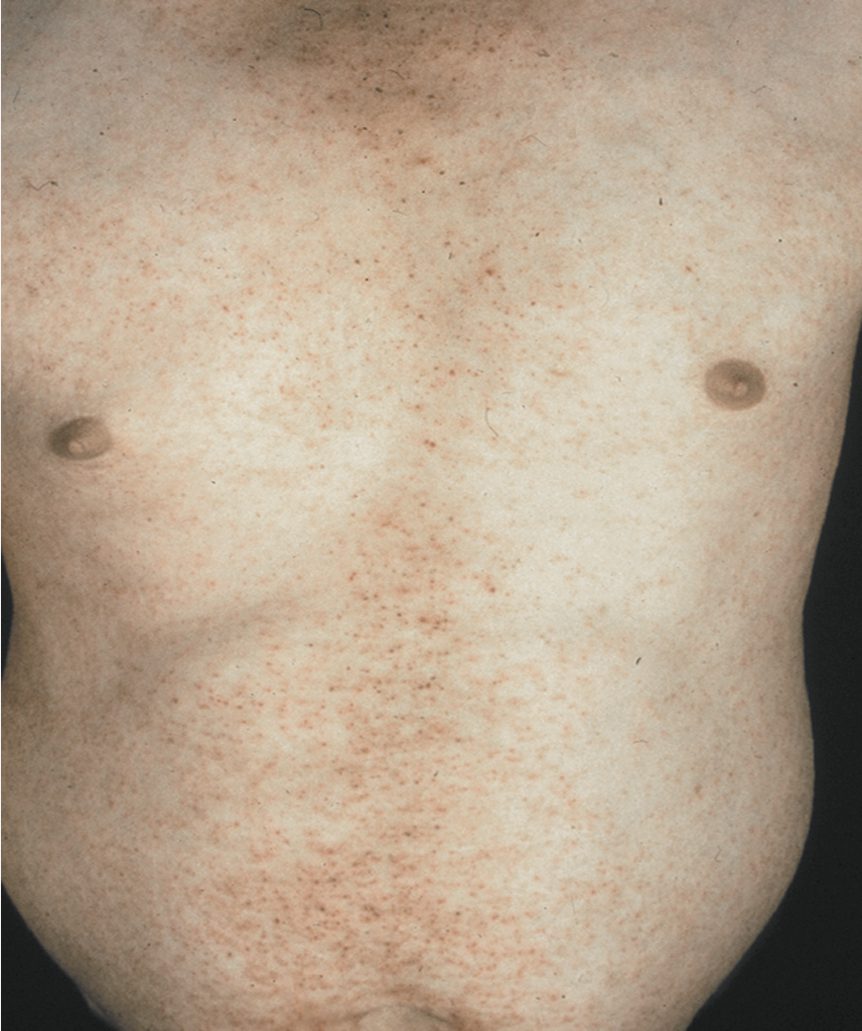
Figure 1. Classic scabies
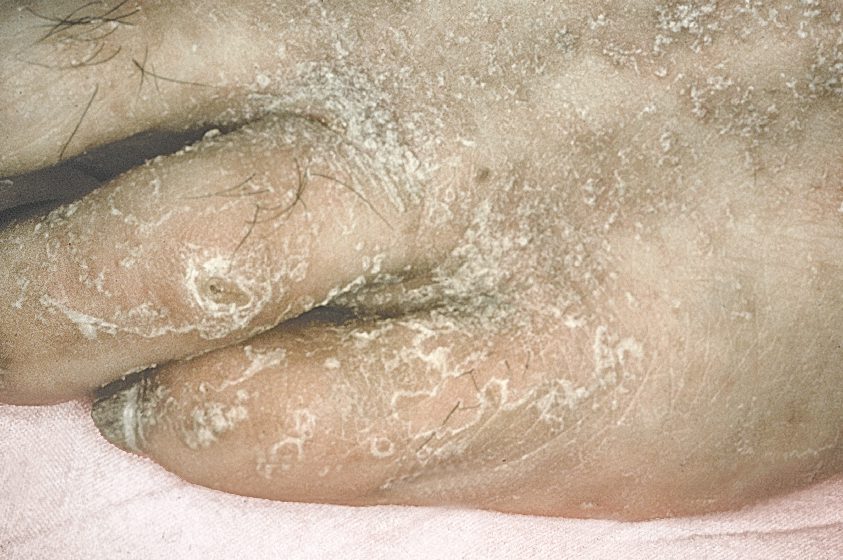
Figure 2. Classic scabies

Figure 3. Crusted (Norwegian) scabies
Diagnosis
Diagnosis is mainly clinical, can be supported with microscopy (e.g., skin scraping) that allows the evaluation of scales and can show the mites, their eggs or feces. The dermatologists can have additional detection tools in their arsenal (e.g., dermatoscopes).

Figure 4. Body distribution of classic scabies

Figure 5. Sarcoptes scabiei
Treatment
There are a few treatment options and regimen should be individualized based on the patient’s presentation and needs:
- Topical permethrin (5%) → is considered the first line in the United States. Acts on both adults and eggs, therefore is highly effective after a single application.
- May induce local cutaneous reactions after use
- Can be used in pregnancy
- Oral ivermectin → Acts only on adults and thus needs to be redosed after 14 days.
- Use with caution in patients with possible filarial co-infection
- Not recommended in pregnancy
- Topical sulfur compounds (5-10%) → widely used in developing countries. Typically used for 3 days.
- May induce local cutaneous reactions and ointment has unpleasant odor
- Can be used in pregnancy
For more information (including dosing) about the treatment of scabies, refer to the CDC website.
| Effect | Use in pregnancy | |
| Topical permethrin | Acts on adults and eggs | Yes |
| Topical sulfur compounds | Unclear | Yes |
| Oral invermectin | Acts on adults | No |
Table 1. Scabies treatment options
Classic scabies: the use of one agent is typically sufficient, unless there is treatment failure. There might be slight superiority of permethrin and ivermectin over sulfur compounds.
Crusted scabies: requires combined topical and oral therapy. There are multiple regimens available and dosing schedules depend on the severity of disease.
- Example: Apply daily topical permethrin for 1 week and weekly thereafter until cure PLUS 3-7 doses of ivermectin over a 1-4 week period depending on disease severity.
Management
- Treatment considerations
- Individualize available options to the patient
- Offer additional therapies for pruritus management (emollients, antihistamines, low-potency corticosteroids)
- Recommend treatment to all household members, sexual and close contacts (regardless of the presence of symptoms)
- In severe cases (including in crusted scabies), recommend washing clothes and linen in warm cycle to prevent reinfestation. If crusted scabies is diagnosed during hospitalization, isolation is needed.
- Test for HIV and HTLV-1 in crusted forms or classical forms that are difficult to treat
- Treatment monitoring and response
- Pruritus may paradoxically increase with treatment
- Pruritus may take up to 6 weeks after treatment to fully resolve (since dead parasitic antigens can remain in the epidermis while the skin sheds)
- If no response, a new evaluation (including microscopy) to assess for mite persistence is reasonable
- Scabies is not contagious at least 12 hours after effective treatment
Other Media Resources (Optional)
References
This lesson was built in partnership with Infectotrópico and was last updated August 21 2025