
Mpox
Mpox
Editor: Dimie Ogoina
Section Contents
Background & Epidemiology
Mpox is a zoonotic disease caused by the Monkeypox virus, and it causes fever and a rash; the latter can be cutaneous or mucosal. Many, but not all, patients present with lymphadenopathy and its presence distinguishes it from smallpox/chickenpox (remember this!).
Two genetically distinct types of the Mpox virus have been identified, known as clades (this is high-yield!). Both clade I and clade II are believed to have originated in Africa, though outbreaks involving each clade have been reported outside of endemic areas. Below we summarized the differences between both clades.
| Clade I | Clade II | |
|---|---|---|
| Subtypes | Ia & Ib | IIa & IIb |
| Origin | Central/East Africa | West Africa |
| Clinical presentation | Clade Ia: lesions generalized centrifugal distribution | Clade IIa: lesions generalized centrifugal distribution |
| Clade Ib: lesions generalized centrifugal distribution and localized to anogenital region | Clade IIb: lesions localized to anogenital region | |
| Severity | Clade Ia more severe (mortality rate ~10%) | Less severe (mortality rate <5%) |
| Clade Ib not significantly different from IIb | ||
| Examples of recent global outbreaks | 2024 (Ib) | 2022 (IIb) |
Transmission to humans occurs via three main routes that varies by clade, geographical setting and risk groups:
(i) Rainforest setting (Clade Ia/IIa): transmission is driven by close contact of humans with infected animals (“zoonotic spillover”) during hunting, butchering, bites/scratches from animal reservoirs; notably, monkeys or rodents (e.g., prairie dogs). This transmission route occurs among the rainforests of West and Central Africa.
(ii) Peri-urban setting (Clade Ia/IIa): limited human-human transmission typically in chains of 2-3 people following household or nosocomial contact within a neighboring town or village of West and Central Africa.
(iii) Urban setting (Clade Ib/IIb):
Clade Ib (2024 outbreak) emerged in eastern DRC and spread to neighboring countries through direct contact and sexual transmission in urban settings, affecting people of all ages.
Clade IIb (2017-2019 Nigeria outbreak and 2022 global outbreak) sexual contact is the predominant route (particularly condomless receptive anal sex. MSM accounts for ~90% of cases.
Less commonly: contact with contaminated fomites or needlestick injuries
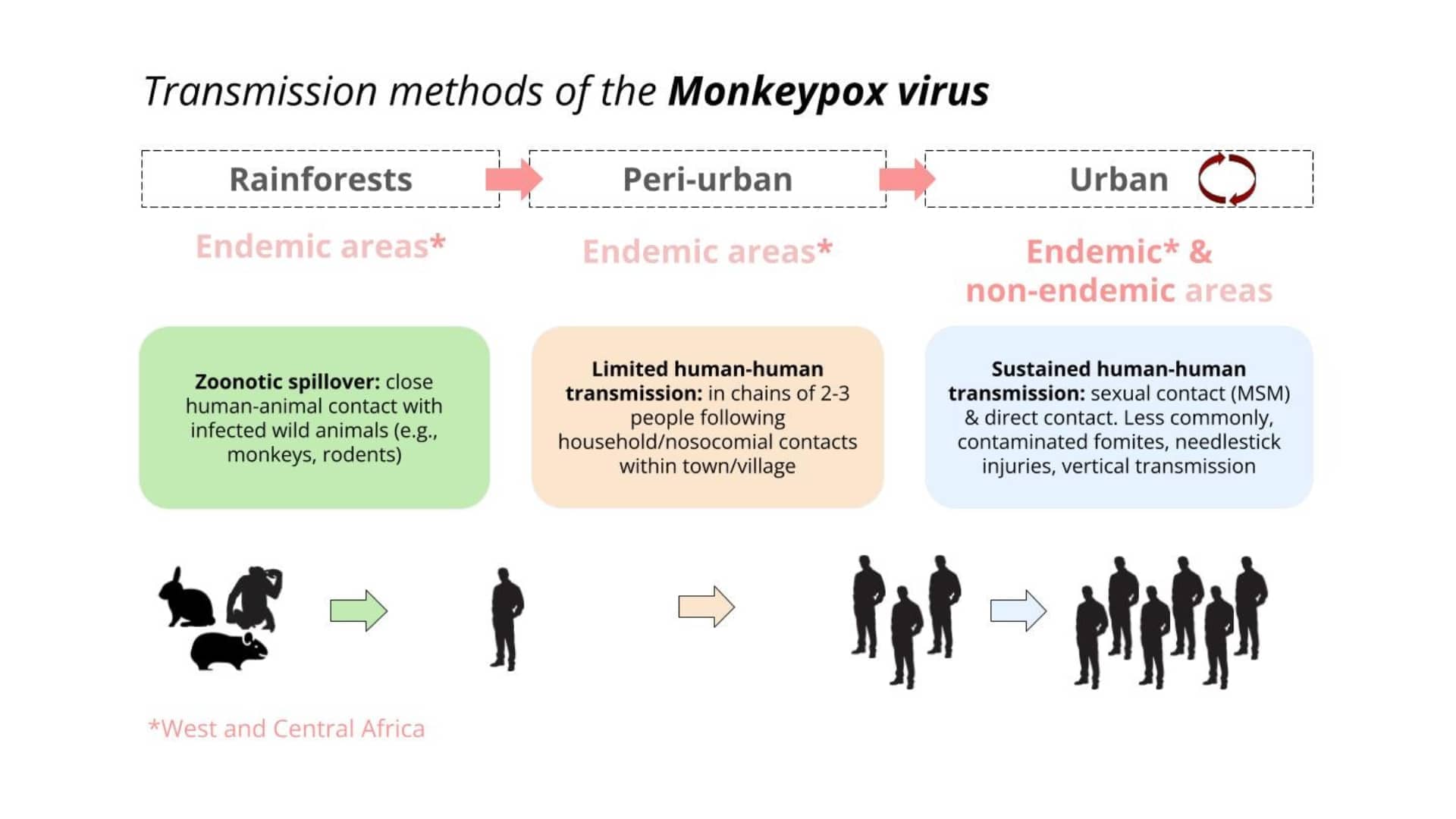
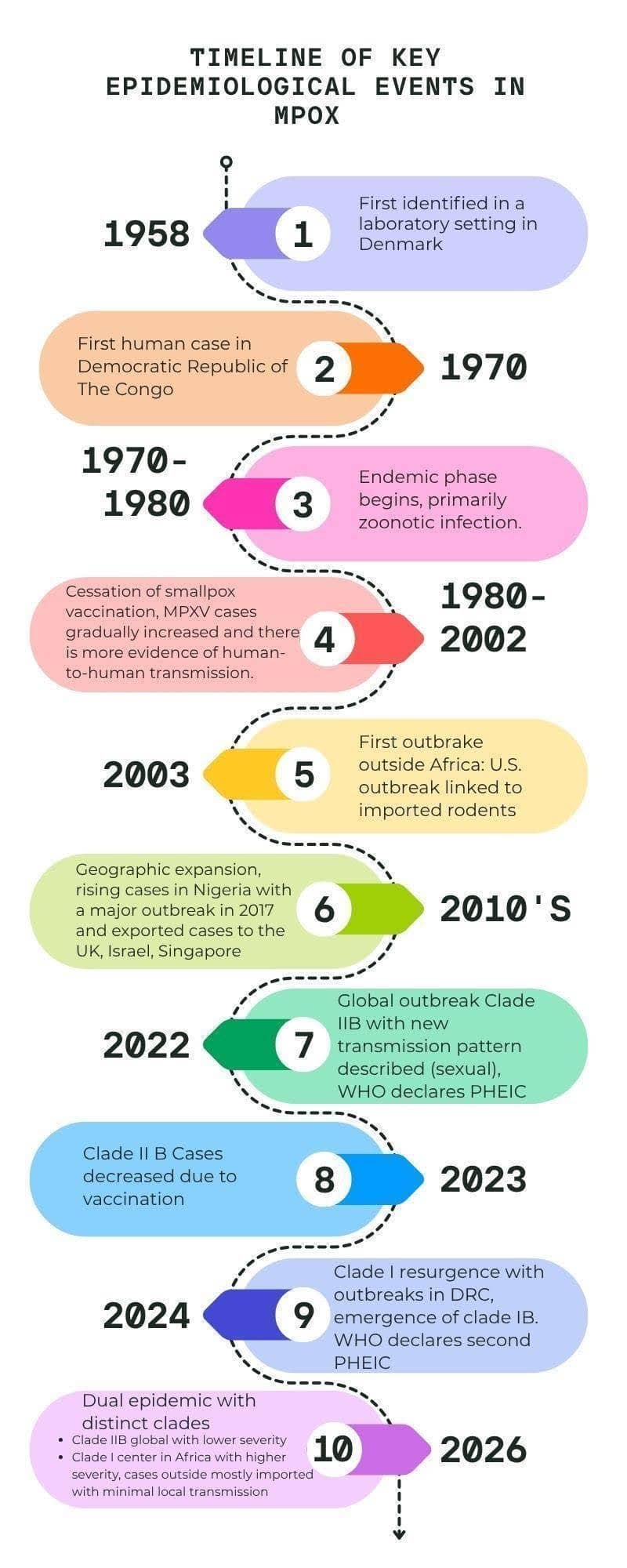
History pearl: decades ago, Mpox was primarily recognized in rural communities in Central and West Africa, and transmission was driven through the contact of humans with infected animals (called “zoonotic spillover”), with a more limited human-to-human transmission. In more recent decades, however, Mpox has spread well beyond its historical endemic areas; some outbreaks have gained notable international attention (e.g., outbreaks in 2022, 2024). In contrast to prior cases, more recent epidemics have occurred primarily due to direct physical contact (Clade Ib, IIb). Clade IIb was commonly transmitted in the context of sex, predominantly among men who have sex with men. This is probably all you need to know, but if you’re a history nerd like us, there’s a more in-depth timeline of key events in Mpox below:
For how long are individuals contagious with Mpox?
Answer
Individuals are contagious from symptom onset until all lesions have healed, scabs have fallen off, and a fresh layer of skin has formed. This often takes 2-4 weeks.