
Malaria I
Malaria I
Editor: Jennifer Small-Saunders
Section Contents
Buckle up! Malaria will arguably be the longest lesson in our curricular series! It’s so long and so important that it deserves two parts. Part I includes all introductory aspects to the epidemiology, biology, and clinical presentation of malaria; and Part II includes the most high yield concepts in diagnosis, treatment and prevention. Let’s begin…
Background
Malaria is a mosquito-borne parasitic disease caused by protozoa of the genus Plasmodium. The word malaria comes from the italian term “mal aria” which translates to “bad air”, as it was believed to be transmitted through the air from swamps and marshes.
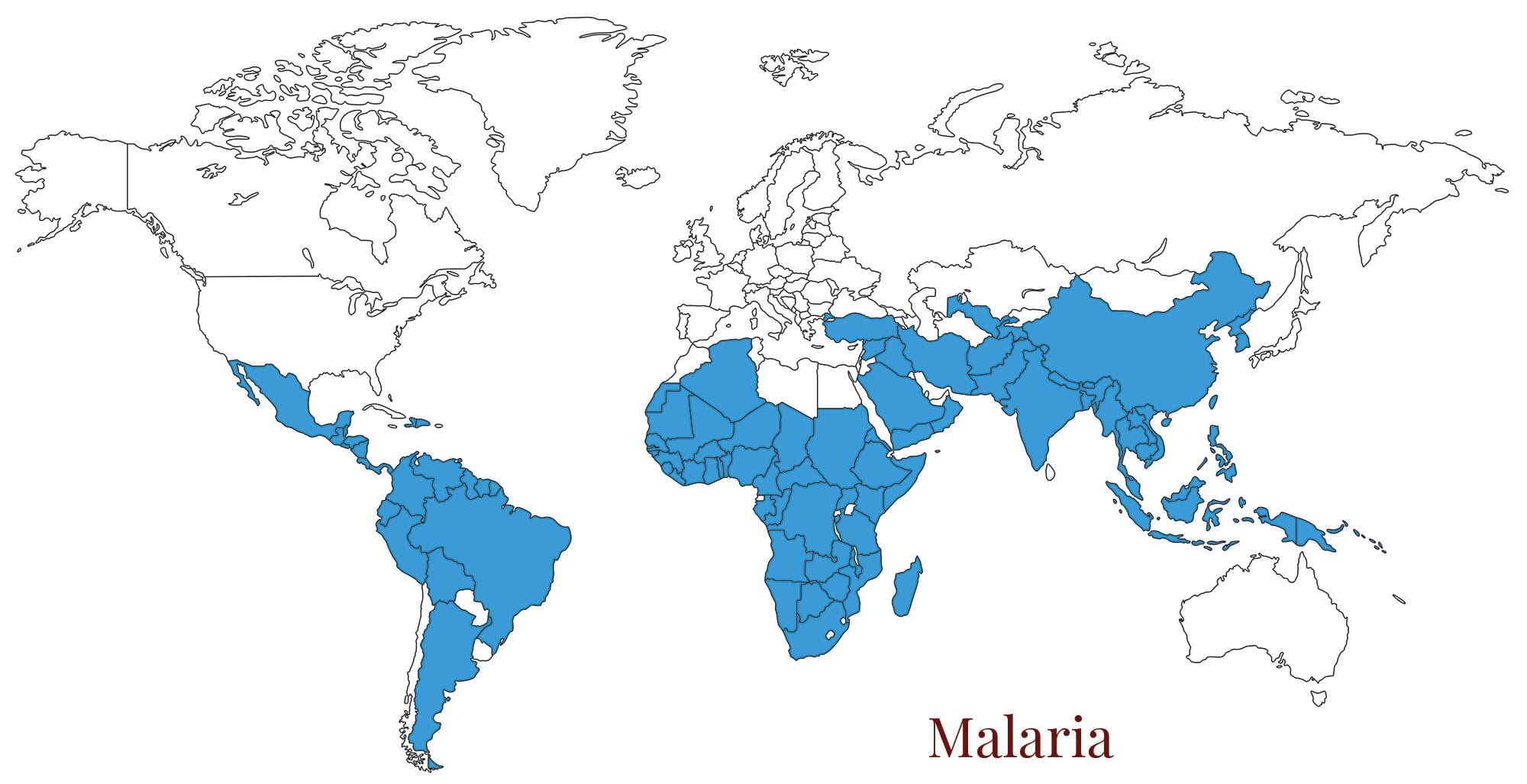
Malaria is arguably the most important parasitic infection worldwide, and it is common among tropical and subtropical areas of the world. According to the WHO (2024), there were close to 263 million cases worldwide, and approximately 597,000 malaria deaths in 2023. The majority of cases and deaths occur in sub-Saharan Africa, mostly in children under 5 years of age. There are five species known to infect the human host: P. falciparum, P. vivax, P. ovale, P. malariae, and P. knowlesi.
Epidemiology & Biology
Malaria is transmitted by the bite of the female Anopheles mosquito. The majority of species are predominantly night-biters, with most biting peaks occurring after dusk. Anopheles spp. (like other mosquitoes) breeds in water, thus rainfall and temperature are positively correlated with malaria incidence. An outline of the most medically-relevant features of Anopheles spp. in comparison to other arboviral vectors are summarized in the Table below.
| Anopheles | Aedes | Culex | |
| Biting behavior | Night biters | Day biters | Night biters |
| Pathogens transmitted | Plasmodium spp. | Dengue virus, Chikungunya virus, Zika virus, Yellow fever virus, Rift Valley Fever virus | Japanese encephalitis virus, West Nile virus, Rift Valley Fever virus |
Table 1. Comparison between common mosquitoes

Figure 1. Anopheles spp

Figure 2. Aedes aegypti
Life cycle
The life cycle of Plasmodium is complicated, but generally similar among species (except some key differences). It consists of two phases: asexual and sexual. The asexual phase occurs in mammals, and the sexual phase takes place in the mosquito.
- Asexual phase (pre-erythrocytic stage): when the female Anopheles takes a blood meal, it injects salivary fluid into the wound. These fluids contain sporozoites, which travel to the hepatocytes in the liver. Inside the liver, they divide asexually several times - in a process called "liver schizogony ", which generates liver schizonts, each containing tens of merozoites. When schizonts rupture, they release merozoites into the bloodstream that go to invade the erythrocytes.
- Asexual phase (erythrocytic stage): once inside the erythrocytes, merozoites can differentiate asexually or sexually. The majority of merozoites undergo asexual reproduction, progressing from ring stages to early and late trophozoite stages, and then schizonts (composed of tens of merozoites). When schizonts rupture, merozoites are released into the blood stream and invade neighboring erythrocytes. This process (from invasion to release of merozoites in the erythrocytes) is called "blood schizogony". Further, some trophozoites will differentiate sexually into gametocytes. Gametocytes can be male (microgametocytes) or female (macrogametocytes), they accumulate in small skin capillaries where they can be taken up by the Anopheles mosquito in a blood meal, to continue the next part of the cycle. FYI - clinical symptoms are caused by the asexual stages (ring stages, trophozoites, schizonts, merozoites), but NOT by gametocytes.
- Sexual phase: upon ingestion by the mosquito, the gametocytes shed their protective erythrocyte membrane in the gut of the mosquito. Male gametocytes fertilize their female counterparts, resulting in zygotes, and later into oocysts in the gut wall. Each oocyst produces thousands of sporozoites, which migrate and invade the salivary glands. When the female Anopheles bites another human host, sporozoites are introduced into the circulation, and a new cycle begins.

Figure 3. Life cycle of Plasmodium falciparum

Figure 4. Life cycle of Plasmodium vivax/ovale

Figure 5. Life cycle of Plasmodium spp in the mosquito (sporogony)
Pathogenesis
Why is P. falciparum more severe?
Now imagine all these phenomena happening in the same patient! This is why P. falciparum can cause such severe disease. In some cases, it affects the microvasculature of the central nervous system, leading to one of its most feared complications: cerebral malaria.
Clinical Presentation
- P. vivax may take up to 6-12 months;
- P. malariae takes closer to 30 days;
Clinical malaria presents in many different ways. To understand malaria you will need to recognize the symptoms, but also to acknowledge the severity of the disease. This is important because treatment is different! Based on the severity disease, malaria can be classified in uncomplicated or severe:
- Uncomplicated malaria → individuals classically present as an acute febrile syndrome, ("malaria paroxysm"), and many other non-specific symptoms, such as: general malaise, headaches, anorexia, myalgias, arthralgias, jaundice, abdominal discomfort, nausea, or diarrhea. Patients may also have hepatosplenomegaly.
Note: Because symptoms of malaria can be non-specific, any fever or viral-like illness in an individual coming from a malaria endemic region, must make you think of malaria!
- Malaria paroxysm → each paroxysm coincides with the rupture of infected erythrocytes. In the beginning, patients are more likely to be asynchronous, and fever can be daily before typical periodicity is achieved. Over time, schizogonies synchronize and can cause very distinct fever patterns (depends on each species):
- Quotidian fever: fever occurs at daily intervals, as schizogony takes ~24h to occur. Representative of P. knowlesi infections.
- Tertian fever: fever occurs on the 3rd day, as schizogony takes ~48h to occur. Representative of P. ovale/P. vivax (also called “tertian benign fever”), or P. falciparum (also called “tertian malignant fever”)
- Quartan fever: fever occurs on the 4th day, as schizogony takes ~72h to occur. Representative of P. malariae infections.
Note: Although this is frequently described in textbooks, asynchronous parasite’s cycles are not infrequent. These “classic” fever patterns are suggestive, but if the patient is having other fever patterns that does not exclude malaria.What are the causes of massive splenomegaly in the tropics?Answer
- Hyperreactive Malarial Splenomegaly
- Visceral Leishmaniasis
- Brucellosis
- Hepato-splenic schistosomiasis
- Malaria paroxysm → each paroxysm coincides with the rupture of infected erythrocytes. In the beginning, patients are more likely to be asynchronous, and fever can be daily before typical periodicity is achieved. Over time, schizogonies synchronize and can cause very distinct fever patterns (depends on each species):
- Complicated (severe) malaria → occurs when (often P. falciparum) malaria leads to severe end-organ damage and/or metabolic derangements. Criteria for severe malaria per the WHO are listed below. The presence of one or more of the following criteria in the presence of asexual parasitemia with P. falciparum is diagnostic.
| Impaired consciousness |
Glasgow coma score <11 (adults) Blantyre coma score <3 (children) |
| Prostration | Generalized weakness so that the person is unable to sit, stand or walk w/o assistance |
| Convulsions | More than 2 episodes within 24h |
| Acidosis | A base deficit of > 8 mEq/L or, if not available, a plasma bicarbonate level of < 15 mmol/L or venous plasma lactate ≥ 5 mmol/L. Severe acidosis manifests clinically as respiratory distress (rapid, deep, laboured) |
| Hypoglycemia | Blood/plasma glucose <2.2 mmol/L (<40 mg/dL) |
| Severe anemia | Hemoglobin concentration ≤ 5 g/dL or a haematocrit of ≤ 15% in children < 12 years of age (< 7 g/dL and 10 000/µL |
| Renal impairment | Plasma/serum creatinine > 265 µmol/L (3 mg/dL) or blood urea > 20 mmol/L |
| Jaundice | Plasma or serum bilirubin > 50 µmol/L (3 mg/ dL) with a parasite count > 100 000/ µL |
| Pulmonary edema | Radiologically confirmed or oxygen saturation 30/ min, often with chest indrawing and crepitations on auscultation |
| Significant bleeding | Including recurrent or prolonged bleeding from the nose, gums or venipuncture sites; haematemesis or melaena |
| Shock | Compensated shock is defined as capillary refill ≥ 3 s or temperature gradient on leg (mid to proximal limb), but no hypotension. Decompensated shock is defined as systolic blood pressure < 70 mm Hg in children or < 80 mmHg in adults, with evidence of impaired perfusion (cool peripheries or prolonged capillary refill). |
| Parasitemia | P. falciparum parasitaemia > 10% |
Other clinical syndromes in malaria
We want you to know that in certain individuals (especially in those with non-severe malaria), there are distinct clinical syndromes that can happen:
Okay. This was a lot. It's time to take a break. See you in Malaria part II.
Other Media Resources (Optional)
This lesson was last updated August 21 2025