
Malaria II
Malaria II
Editor: Jennifer Small-Saunders
In this second part we will discuss the considerations surrounding diagnosis, treatment and management of malaria. This is probably the hardest part, but we tried our best to explain the most important concepts.
Diagnosis
There are three diagnostic modalities to detect malaria you should be familiar with:
| RDTs | Microscopy | Molecular methods | |
| Limit of detection | >100 parasites/mcL | >50 parasites/mcL | >1 parasite/mcL |
| Key advantages | Rapid turnaround time, easy to perform, inexpensive | Allows species indentification and calculation of parasitemia | High sensitivity, allows species identification |
| Key disadvantages | Cross-reactivity with multiple autoantibodies (e.g., rheumatoid factor) and other diseases (Hepatitis C virus, Salmonella, Dengue virus, T. cruzi, among others); HRP-2 deletions and persistence after treatment | Requires trained microscopists | Lengthy turnaround time, costly, not widely available |
Table 3. Comparison of all available diagnostic methods
Malaria Pharmacology
Before we dive into treatment, it’s important to be familiar with the most commonly used drugs for both the treatment and prevention of malaria. Most of these medications fall into three main drug categories.
-
Artemisinin derivatives: artemisinin is derived from the plant Artemisia annua and is the parent drug for its three main clinically-used derivatives - artesunate, artemether, and dihydroartemisinin. These drugs are highly active against all species of Plasmodium, and act rapidly on all blood stages in the life cycle. However, they have very short half-lives and are therefore combined with second a second drug class (often slowly eliminated) with a distinct mechanism of action to clear the reminder of the parasite burden and avoid the development of resistance - known as artemisin combination therapies (ACT), examples are:
- Examples: artemether-lumefantrine, artesunate-mefloquine, dihydroartemisinin-piperaquine, artesunate-amodiaquine, and artesunate-sulfadoxine-pyrimethamine
- Artesunate is the only one available as IV formulation
- Examples: artemether-lumefantrine, artesunate-mefloquine, dihydroartemisinin-piperaquine, artesunate-amodiaquine, and artesunate-sulfadoxine-pyrimethamine
- Quinoline derivatives → these heterogeneous groups of drugs are chemically related to quinine - which is now considered to be too toxic for routine use, although may still have some role in severe malaria. Remember they all end in “-quine”. With this group, drug toxicities are important and are summarized below.
- Examples: quinine, chloroquine, mefloquine, primaquine, amodiaquine
- Important indications:
- Chloroquine → drug of choice for P. vivax, P. ovale, P. malariae (except in resistant areas), and can be used in chloroquine-sensitive P. falciparum areas
- Primaquine/Tafenoquine → drug of choice (and only option!) for radical cure of hypnozoites in P. vivax and P. ovale
- Mefloquine → more commonly used for prophylaxis, but it is sometimes paired with artemisinin derivatives to produce ACTs (e.g. artesunate-mefloquine) to overcome chloroquine resistance
- Antifolates → these medications interfere in various ways with the metabolism of folic acid and DNA synthesis. They include: sulfonamides (e.g. sulfadoxine), pyrimethamine, dapsone, proguanil. Are often part of drug combinations: sulfadoxine-pyrimethamine, atovaquone-proguanil.
- Miscellaneous → atovaquone, doxycycline, clindamycin
| Relevant side effects | Use in pregnancy | |
| Quinine | Cinchonism, QTc prolongation | Yes |
| Chloroquine | GI upset, retinopathy (uncommon) | Yes |
| Mefloquine | GI upset, neuropsychiatric side effects, seizures | Yes |
| Primaquine | GI upset, hemolytic anemia in G6PD deficiency | No |
| Tafenoquine | GI upset, hemolytic anemia in G6PD deficiency | No |
Table 4. Summary of most common sides effects from quinoline derivatives
Treatment & Management
Managing malaria can get very complicated, because it requires careful consideration of several factors, including: the patient's clinical status, the level of parasitemia, the confirmed or suspected Plasmodium species, prior use of antimalarial prophylaxis, local patterns of drug resistance, and the availability of treatment options at your institution. Both the Centers for Disease Control and Prevention (CDC) and the World Health Organization (WHO) provide comprehensive and easily accessible guidelines for malaria treatment and management. We highly encourage you to keep these resources readily available for quick reference in the event of a suspected or confirmed malaria case.
Just as an educational resource, we will simplify and summarize these recommendations, understanding that this is not comprehensive, nor does it encompass all the nuances of clinical management of malaria. As a quick summary, these are some basic concepts you need to know when treating a patient with confirmed or suspected malaria:
- Recognize malaria
- Determine if case falls under category of uncomplicated or severe malaria (refer to Clinical Presentation)
- Identify the species - remember that for P. vivax and P. ovale after completing the treatment course, either primaquine or tafenoquine will need to be added to treat hypnozoites!
If no resistance is suspected or present, these are the drugs of choice:
| Uncomplicated Malaria | Severe Malaria | |
| P. falciparum | ACTs | IV Artesunate |
| P. knowlesi | ACTs | IV Artesunate |
| P. malariae | Chloroquine | IV Artesunate |
| P. vivax, P. ovale | Chloroquine + Primaquine/Tafenoquine | IV Artesunate |
Table 5. Comparing treatment strategies per Plasmodium spp
Some of the selection or duration of the regimens described above may change if an individual acquired malaria in one of the areas of drug resistance. Keep these table close to you for reference:
| P. falciparum chloroquine-sensitive areas | Caribbean and Central America west of the Panama Canal |
| P. falciparum ACTs-resistant areas | Greater Mekong subregion (GMS) and Africa -- specifically in Eritrea, Rwanda and Uganda |
| P. falciparum mefloquine-resistant areas | Southeast Asia on the borders of Thailand with Burma (Myanmar) and Cambodia, in the western provinces of Cambodia, in the eastern states of Burma on the border between Burma and China, along the borders of Burma and Laos, and in Southern Vietnam |
| P. vivax chloroquine-resistant areas | Papua New Guinea and Indonesia |
Table 6. Most common areas of resistance to common antimalarials
Managing special scenarios
Prevention
- Vector avoidance → avoid outdoor spaces from dawn to dusk (highest activity of the mosquito), apply mosquito repellent, use metallic fabric in doors and windows, spray insecticides in the rooms overnight, avoid malaria endemic zones (particularly if pregnant!), use clothes that covers exposed areas, use of mosquito nets + insecticide-treated nets;
- Vector control → use of larvicides, destruction of breeding sites, DDT (used in the past, but use was waned due to cost and environmental consequences), indoor residual spraying;
- Chemoprevention: are strategies employed to prevent malaria disease; however, they DO NOT prevent malaria infection or its initial liver stages. In English, this means that individuals can still get malaria, but the parasite is killed by the chemotherapeutic agent before it causes any symptoms. Because it does not prevent the formation of hypnozoites, certain individuals can still relapse following the use of chemoprevention.
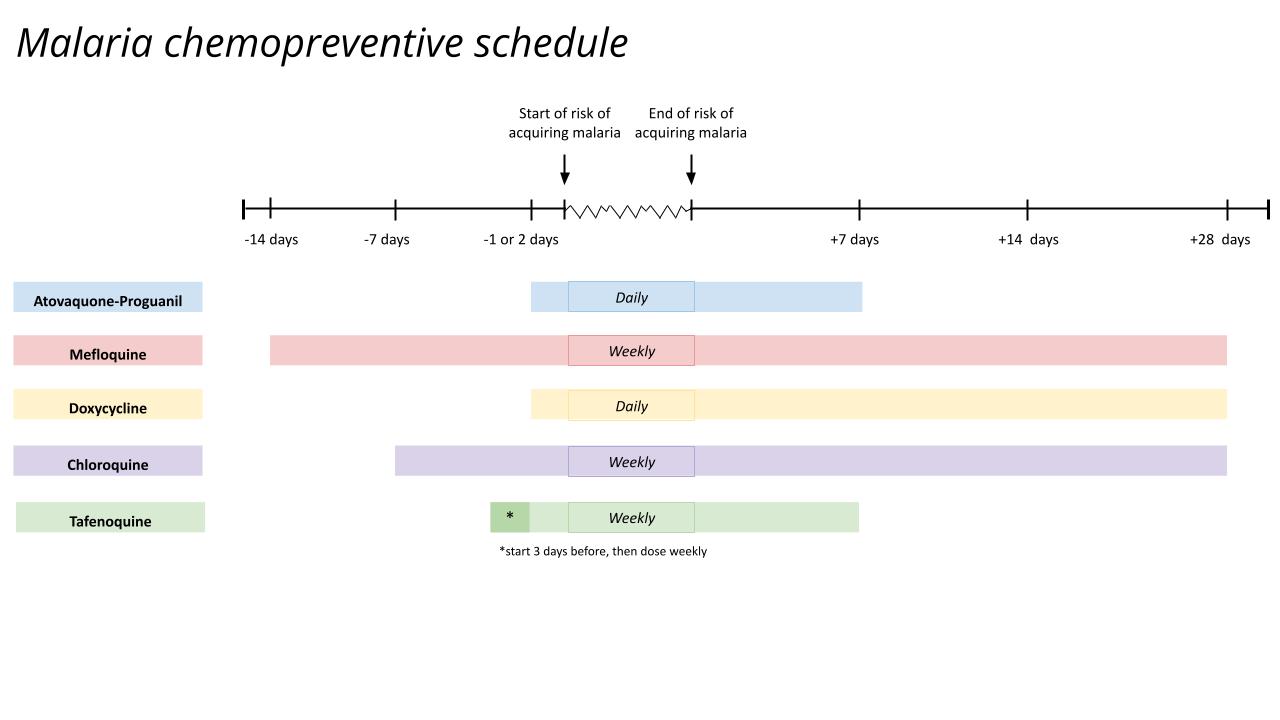
- Chemoprophylaxis → used typically in travelers - often non-immune individuals- going from a non-endemic to an endemic area. These drugs prevent malaria disease, but not malaria infection, and thus they need to be taken some time before (need time to work) and have to be stopped some time after travel (to kill any circulating parasites). Drug options should be individualized to the patient’s travel schedule, preference, tolerability, resistance profile in area of travel, and cost. Options are summarized in the table and diagram below:
Site of action Schedule High-yield side effects Contraindications Atovaquone- proguanil Acts on liver and blood stages 1-2 days before; daily during travel; 7 days after return GI upset; headaches. Can be costly Pregnancy Considerations → ideal for short trips Mefloquine Acts on blood stages 14 days before; weekly during travel; 28 days after return GI upset, anxiety, vivid dreams, visual side effects Psychiatric disorders, epilepsy, arrhythmias Considerations → consider in pregnancy; avoid in Southeast Asia Doxycycline Acts on blood stages 1-2 days before; daily during travel; 28 days after return Pill-esophagitis, Photosensitivity, Yeast infections Pregnancy, Children <8 Considerations → prevents acne, also acts as prophylaxis for leptospirosis and rickettsioses Chloroquine Acts on blood stages 7 days before; weekly during travel; 28 days after return GI upset Psoriasis Considerations → consider in pregnancy; avoid in most areas of the world Tafenoquine Acts on liver and blood stages 3 days before; weekly during travel; 7 days after return Hemolytic anemia in G6PD deficiency Pregnancy, Lactation, G6PD deficiency Considerations → when used for radical cure can only be used with chloroquine Table 7. Most common drugs used in malaria prevention
- Seasonal malaria chemoprevention → this strategy is employed in areas with seasonal transmission of malaria (e.g., rainy season in West Africa) and consists in giving children under the age of 5 courses of anti-malarial treatment regardless of the presence of symptoms. Regimens should be dissimilar to first-line drugs used in that area to minimize resistance.
- Mass drug administration → this strategy consists in giving antimalarials to most individuals at risk in an endemic area to decrease prevalence and interrupt transmission.
- Intermittent preventive treatment in pregnant women → explained above in “malaria in pregnancy"
- Chemoprophylaxis → used typically in travelers - often non-immune individuals- going from a non-endemic to an endemic area. These drugs prevent malaria disease, but not malaria infection, and thus they need to be taken some time before (need time to work) and have to be stopped some time after travel (to kill any circulating parasites). Drug options should be individualized to the patient’s travel schedule, preference, tolerability, resistance profile in area of travel, and cost. Options are summarized in the table and diagram below:
- Vaccination: there are two vaccines recommended by the WHO (RTS,S and R21). Both act by inducing antibodies that prevent sporozoites from infecting hepatocytes. Clinical efficacy is over 30%, but benefit is synergistic with other strategies (i.e., chemoprevention). Currently only recommended in children living in endemic areas - especially those in areas of moderate to high transmission.
Assessment: Did I Get It? (DIG IT)
DIG ITs are online modules designed to reinforce key learning points for you! Please choose the best answer, then check all of the answer choices for more learning pearls
References
This lesson was last updated August 21 2025