Mpox

Mpox

Authors: Carolina Ricaurte, Jorge Cardenas-Alvarez

Editor: Dimie Ogoina

Background & Epidemiology

Mpox is a zoonotic disease caused by the Monkeypox virus, and it causes fever and a rash; the latter can be cutaneous or mucosal. Many, but not all, patients present with lymphadenopathy and its presence distinguishes it from smallpox/chickenpox (remember this!). 

Two genetically distinct types of the Mpox virus have been identified, known as clades (this is high-yield!). Both clade I and clade II are believed to have originated in Africa, though outbreaks involving each clade have been reported outside of endemic areas. Below we summarized the differences between both clades.

Mpox Clade Comparison
Clade I Clade II
Subtypes Ia & Ib IIa & IIb
Origin Central/East Africa West Africa
Clinical presentation Clade Ia: lesions generalized centrifugal distribution Clade IIa: lesions generalized centrifugal distribution
Clade Ib: lesions generalized centrifugal distribution and localized to anogenital region Clade IIb: lesions localized to anogenital region
Severity Clade Ia more severe (mortality rate ~10%) Less severe
(mortality rate <5%)
Clade Ib not significantly different from IIb
Examples of recent global outbreaks 2024 (Ib) 2022 (IIb)
Note: How is the Monkeypox virus transmitted?

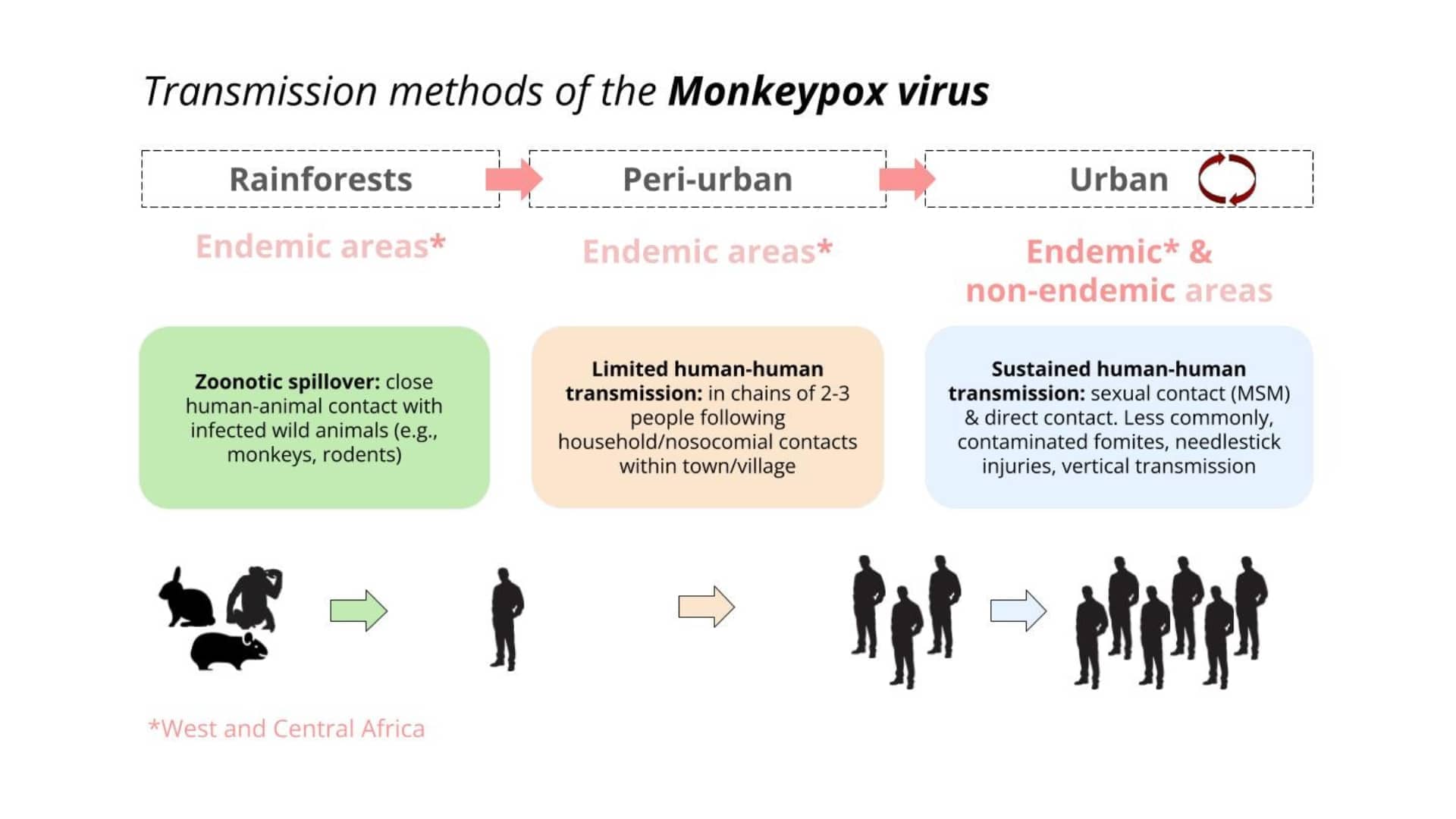
Transmission to humans occurs via three main routes that varies by clade, geographical setting and risk groups:

(i) Rainforest setting (Clade Ia/IIa): transmission is driven by close contact of humans with infected animals (“zoonotic spillover”) during hunting, butchering, bites/scratches from animal reservoirs; notably, monkeys or rodents (e.g., prairie dogs). This transmission route occurs among the rainforests of West and Central Africa.

(ii) Peri-urban setting (Clade Ia/IIa): limited human-human transmission typically in chains of 2-3 people following household or nosocomial contact within a neighboring town or village of West and Central Africa.

(iii) Urban setting (Clade Ib/IIb):

Clade Ib (2024 outbreak) emerged in eastern DRC and spread to neighboring countries through direct contact and sexual transmission in urban settings, affecting people of all ages.

Clade IIb (2017-2019 Nigeria outbreak and 2022 global outbreak) sexual contact is the predominant route (particularly condomless receptive anal sex. MSM accounts for ~90% of cases.

Less commonly: contact with contaminated fomites or needlestick injuries
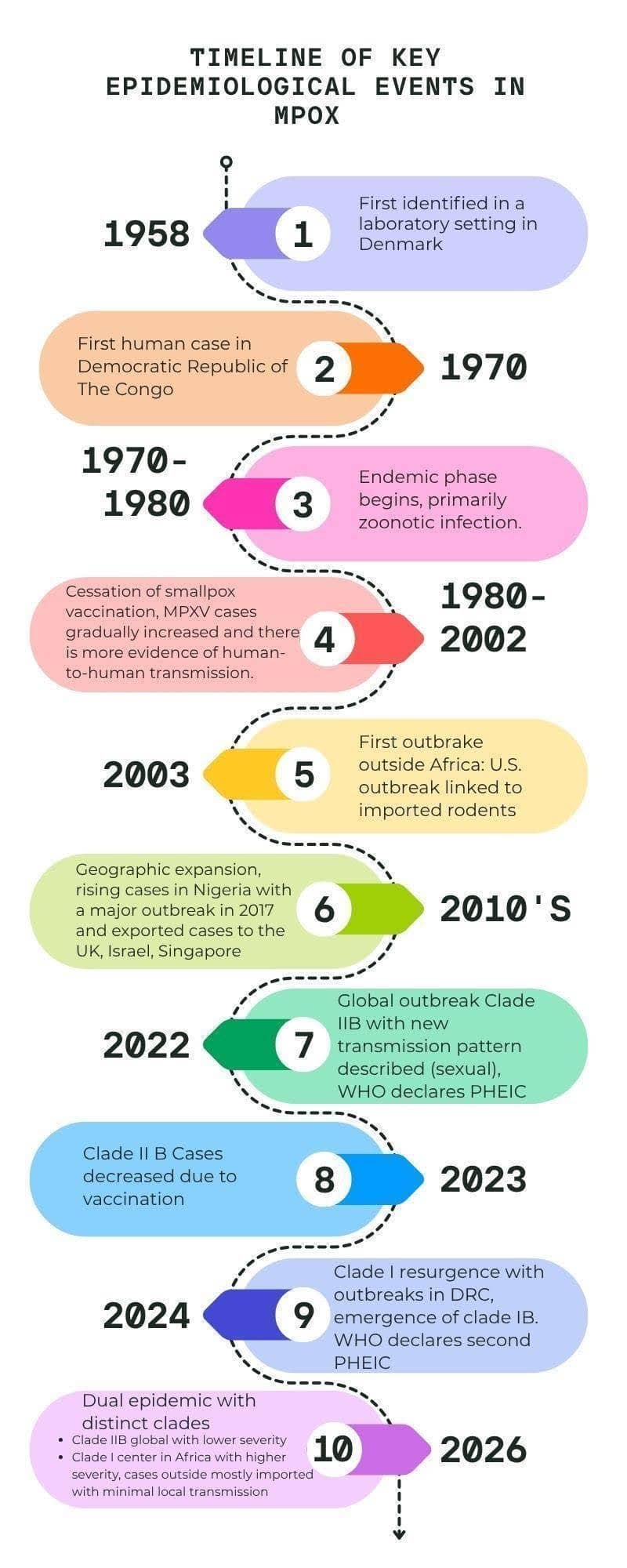
History pearl: decades ago, Mpox was primarily recognized in rural communities in Central and West Africa, and transmission was driven through the contact of humans with infected animals (called “zoonotic spillover”), with a more limited human-to-human transmission. In more recent decades, however, Mpox has spread well beyond its historical endemic areas; some outbreaks have gained notable international attention (e.g., outbreaks in 2022, 2024). In contrast to prior cases, more recent epidemics have occurred primarily due to direct physical contact (Clade Ib, IIb). Clade IIb was commonly transmitted in the context of sex, predominantly among men who have sex with men. This is probably all you need to know, but if you’re a history nerd like us, there’s a more in-depth timeline of key events in Mpox below:
Quiz yourself!
For how long are individuals contagious with Mpox?

Answer

Individuals are contagious from symptom onset until all lesions have healed, scabs have fallen off, and a fresh layer of skin has formed. This often takes 2-4 weeks.

(Very) Basic pathophysiology

The Monkeypox virus enters the body at the site of exposure, where it replicates within host cells typically within 1-2 weeks. The virus then infects nearby immune cells, regional lymph nodes, and disseminates systemically. The severity of disease differs between clades. For example, Clade II infections are more commonly localized, since viral replication is confined to the skin/lymph nodes. In contrast, Clade Ia infections can be more severe, since they can disseminate systemically.

Clinical Presentation

Mpox ranges from a mild/self-limiting illness to severe disease. The latter is seen more commonly among high-risk groups (e.g., immunosuppression, pregnancy). Following an incubation period of up to 21 days (typically 1-2 weeks), individuals exhibit painful (this is important to remember!), well-circumscribed, often umbilicated vesiculopustular skin lesions at the site of inoculation, and can be accompanied by lymphadenopathy. Lesions progress from macules to papules, then vesicles, pustules and crusts, and may eventually lead to permanent scarring. Importantly, systemic symptoms (e.g., fever, chills, malaise) may or may not be present before or during the illness. Please find some reference pictures through the CDC.

Beyond cutaneous disease, clinicians should recognize manifestations such as proctitis, oropharyngeal and ocular disease. Don’t get fooled! An individual with no rash, but with rectal or pharyngeal lesions can still have Mpox! Severe complications include: pneumonia, encephalitis, liver injury, and a severe necrotizing form that has been described in immunocompromised patients.

Note: During the Clade IIb (2022) outbreak lesions were commonly seen in sites involved in sexual activity (genitals, anus, mouth). In endemic/rural areas, rash from Clade I tends to be more frequent in the head/face and extremities.

Diagnosis

Suspect Mpox in individuals with a compatible rash, oropharyngeal or anorectal disease, and lymphadenopathy, when accompanied by an epidemiologic risk factor such as close sexual contact (e.g., MSM) or from endemic areas. 

PCR is the diagnostic method of choice. PCR is collected by swabbing the lesion. Ideally (if available) clade-specific testing should be done. Do not use serology!

Note: Because of the risk of co-infection with sexually transmitted infections (STI), individuals with suspected/confirmed Mpox should also be screened for HIV, Chlamydia/Gonorrhea, Hepatitis B and C. In women, consider screening for trichomoniasis.

Although Mpox is not an STI, transmission during the 2022 and 2024 outbreaks occurred predominantly through close physical contact during sexual activity. Don’t miss those co-infections (chicken pox is an important differential diagnosis in tropical settings)!. In addition, HIV-negative individuals may benefit from PrEP! #AddressMissedOpportunities.

Treatment

Treatment is supportive for the majority of cases. Antiviral therapy (e.g., tecovirimat, brincidofovir, or cidofovir) should be reserved for patients with severe disease (pneumonia, encephalitis, or extensive mucocutaneous involvement) or those with severe immunosuppression who are at high risk for complications. Do not treat this alone! Management of these cases should be undertaken in consultation with an expert.

Note: RCT is yet to show significant clinical benefit of tecovirimat when compared to placebo (disappointing)

Prevention

This is, arguably, the most important part! Prevention is VIA three main strategies: 

  • Vaccination: recommended for individuals at risk (e.g, sexually active gay and bisexual men, MSM, transgender/non-binary), or can be administered as post-exposure prophylaxis. There are two vaccines available: 
    • Jynneos (preferred option) → non-replicating live vaccine administered as a two-dose series. Considered safer for immunocompromised individuals.
    • ACAM2000 (alternative) → live replicating vaccinia (Smallpox) vaccine given as a single-dose and serves as an alternative in selected patients.
  • Isolation: individuals are advised to remain isolated until all lesions have healed, scabs have fallen off, and a fresh layer of skin has formed! In the hospital, individuals with Mpox should be placed under standard + contact + droplet/airborne precautions (this is sometimes a test question).
  • Avoiding exposure: avoiding close skin-to-skin contact with infected individuals, refraining from sharing personal or household items, practicing frequent hand hygiene, and reducing behaviors associated with a higher risk of exposure.

References

This lesson was last updated September 1, 2026.