
Yellow Fever
Yellow Fever
Editor: Alfonso J. Rodriguez-Morales
Key Points
- Yellow Fever (YF) is a mosquito-borne viral disease transmitted and can lead to severe hemorrhagic complications with multiorgan failure.
- About 90% of the cases are found in Africa, and less commonly in South America.
- Diagnosis can be confirmed by RT-PCR in the first 3-4 days of the disease, but more often may be done by documenting IgM seroconversion of convalescent serum.
- Vaccination is highly effective and confers long-lasting immunity, except in a small subset of patients which may require booster doses.
- Rarely, YF vaccine can induce neurotropic or viscerotropic disease in susceptible individuals.
General Concepts
Yellow fever (YF) is a mosquito-borne anthropo-zoonosis caused by the Yellow Fever Virus (YFV) - a Flavivirus. The name "yellow fever" alludes to the icteric sclera and mucosa of those who contract the virus, but it is misleading as this is not universally present. Historically, it has also been called the “black vomit” because of the appearance of the hematemesis in reference to the hemorrhagic complications of YF.
NOTE: Medically relevant Flaviviruses:
- Dengue virus
- Yellow fever virus
- Japanese/St Louis encephalitis virus
- Powassan virus
- West Nile virus
- Zika virus

Figure 1. Aedes aegypti
Epidemiology & Transmission
To date, there is only transmission of YFV in certain regions of South America and Sub Saharan Africa. About 90% of cases worldwide occur in Africa. The virus is transmitted between hosts (animal-animal, animal-human, or human-human) via a mosquito and circulates in different transmission cycles:
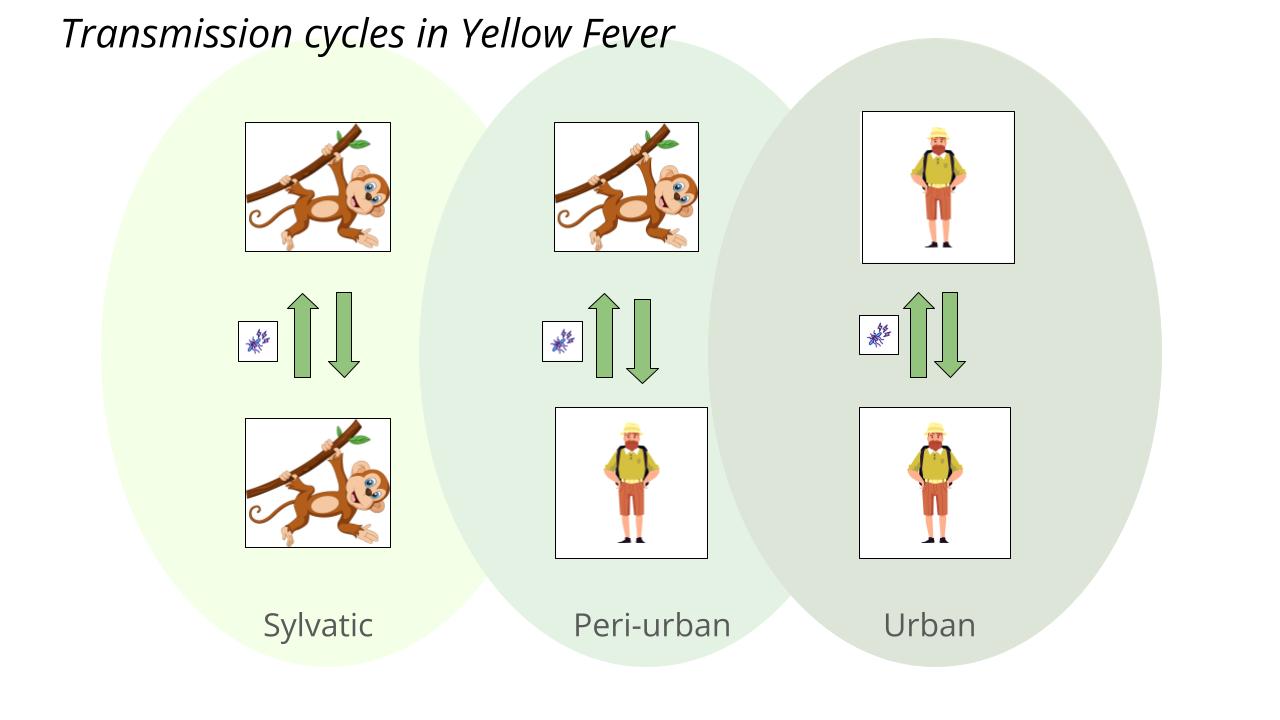
| Sylvatic cycle | Savannah cycle | Urban cycle | |
| Distribution | Africa & South America | Africa | Africa & South America |
| Pricipal vector | Africa: Aedes | Africa: Aedes | Africa: Aedes |
| South America: Aedes, Haemagogus, & Sabethes | South America: Aedes | South America: Aedes | |
| Hosts involved | Animal-Animal | Animal-Human Human-Human | Human-Human |
Note: Arboviruses transmitted by Haemagogus spp. (in South America):
- Yellow fever
- Mayaro virus
Clinical Presentation & Pathogenesis
Incubation period is 3-6 days. The course of the disease is classically described in two phases:
- Mild cases (75-85%)/Acute phase: can range from asymptomatic to mild symptoms - characterized by a nonspecific febrile illness plus headaches, chills, nausea, vomiting, myalgias, weakness, and malaise. Typically lasts 3-4 days.
- Severe cases (15-25%)/Toxic phase: after a remission of hours to days, the symptoms relapse with very acute-onset high-grade fever >40C, chills, headaches, myalgias, conjunctival injection, and can progress to multiorgan failure. This phase reflects the viscerotropic nature of the YFV (invasion to multiple tissues, with intense replication in the liver leading to a cytokine storm). Multisystem involvement is as follows:
- Neurologic: toxic metabolic encephalopathy → agitation, stupor, coma.
- Cardiac: intrinsic cardiac damage → Faget’s sign (relative bradycardia), shock.
- Hepatic: acute liver failure → jaundice (“yellow fever”).
- Renal: acute renal failure → oliguria.
- Hematologic: coagulopathy & disseminated intravascular coagulation → bleeding tendency (epistaxis, gastrointestinal bleeding (“black vomit”), purpura).
Prognosis: Mortality is about 50% with no medical attention and typically occurs 7-10 days into the illness. Infection confers life-long immunity for those who survive.
Diagnosis & Treatment
Diagnosis is challenging and it is suggested to consult with a specialist. There are two main testing modalities:
- RT-PCR: can be detected in serum samples during the first days of symptom onset, but YFV viremia is quite short (about 3-4 days). A positive result confirms the diagnosis. A negative result DOES NOT exclude the diagnosis.
- Serology (ELISA, microsphere immunoassay): IgM appears during the first week of illness and can be detected up to 3 months following infection. Laboratory confirmation requires seroconversion of convalescent plasma (at least 1 week apart). Does not differentiate between natural infection and immunization. For full algorithm recommend consulting the PAHO/WHO guidelines (page 4).
There is no specific antiviral treatment for YF. Treatment is supportive (ie, intravenous fluids, transfusion of blood products as needed, reversal of coagulopathy, dialysis).
General Prevention
- Vector avoidance: use insect repellents, permethrin-sprayed clothes, protective clothing (long pants & sleeves), and nets.
- Vector control: decrease mosquito breeding sites (dump stagnant water), mosquito traps.

Figure 2. Yellow fever vaccination card
Yellow Fever Vaccine
This is arguably, the most important section of the whole module - because depending on where you practice, you will deal with the Yellow Fever vaccine more often than with the virus itself. It's out of our scope to explain all nuances, but we outlined the most high-yield concepts for you! (click here for more information).
The YF vaccine is a live attenuated vaccine made out of the 17D strain. Please click through the options below for more information:
References
This lesson was last updated September 4 2025