English
  Spanish
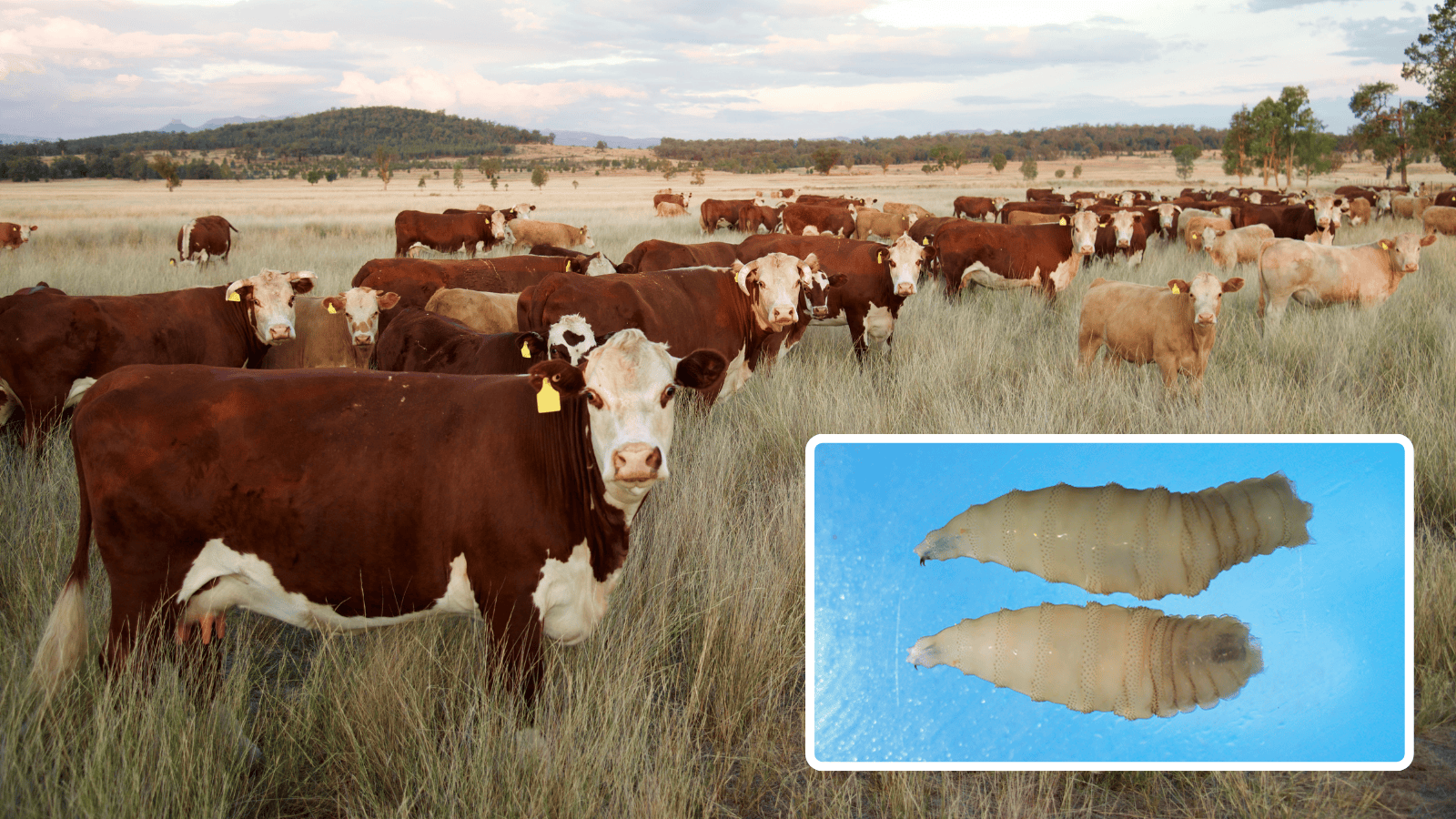
The New World screwworm (NWS), or Cochliomyia hominivorax, has been making headlines in North America recently. The NWS is a parasitic fly that lays its eggs in open wounds and body openings. It is mostly known for affecting animals, especially the cattle trade, where it has serious health and economic impacts. The NWS is typically found in South America and parts of the Caribbean; however, it has been moving northward, expanding into every country in Central America and Mexico.
“The NWS fly will find so much as a tiny scratch, and lay its eggs in the scratch,” says Dr. Daniel Griffin, Parasites Without Borders Co-Founder and President. “And then those eggs will hatch into maggots or larvae, and those maggots will aggressively burrow in and eat healthy flesh.” The parasite was largely eradicated in the United States in the 1970s, while Central America and Mexico had been mostly free of cases for the past 20 years. This was thanks to Edward F. Knipling, an entomologist who discovered in 1937 that NWS have an unusual mating ritual.
Male flies mate indiscriminately, while females mate only once in their lives. Knipling released sterilized male flies, which would mate with fertile females, who would then never reproduce, ultimately sterilizing them. His team created a factory in the 1950s, churning out sterilized males. By the late 1960s, screwworms had been completely eliminated in the United States, and in the following decades, Knipling’s sterilized flies moved south through Mexico and Central America, eliminating the NWS from North America entirely.
Now, the NWS is resurfacing in North America. Human cases started to emerge in Panama in 2023 and in various Central American territories beginning in 2024. The Centers for Disease Control issued a Health Alert Network Health Advisory on January 20, 2026, to, according to the advisory, “notify clinicians, public health authorities, and the public about recent New World Screwworm (NWS) animal cases in the Mexican state of Tamaulipas, which shares a border with the U.S. state of Texas.” Dr. Daniel Griffin and Vincent Racaniello discussed this advisory on This Week in Virology episode 1290: Clinical Update with Dr. Daniel Griffin. “I feel like this is 18 months too late, because we’ve been talking about this for a while.” Dr. Griffin has discussed the reemergence of NWS in many episodes of TWiV and TWiP for the past year.
The first case detected in the U.S. was on June 3, 2026, in a calf in South Texas. In just two weeks, the total confirmed cases have risen to 12, with cases occurring in cows, sheep, goats and one canine. Human cases have already been detected in Mexico. “This is horrible for the cattle industry, horrible for human beings and horrible for wild animals,” says Dr. Daniel Griffin.
To learn more about the NWS outbreak and other current medical events, listen to This Week in Parasitism, This Week in Virology, and Infectious Disease Puscast on MicrobeTV.
Situation Dashboards

World Health Organization (WHO)

Johns Hopkins University (JHU)

COVID-19 in US and Canada